Ledger vs Trezor (2026): Security Models, Prices and Which to Buy
Ledger versus Trezor now comes down to one question: do you want to be able to read the code that guards your key? Both brands put the key in a certified secure element, both start under $70 (Trezor Safe 3 at $59, Ledger Nano S Plus at $69, listed on 10 Oct 2026), and none of the incidents on record involved keys being pulled out of a device in normal use. Trezor publishes its firmware as open source; Ledger keeps its operating system closed and relies on chip certification. Choose Trezor if auditability matters most to you, Ledger if you want the widest choice of screens and wireless options, and either if what you really need is a good backup habit.
Both line-ups changed in late 2025, with a Trezor Safe 7 and a Ledger Nano Gen5 joining the range, so most comparisons still circulating quote models or prices that no longer apply. This version uses the makers' own pages: prices read from a US connection on 10 October 2026, specs from the comparison pages checked on 9 October 2026, and incidents from each company's own disclosures where they exist.
The core difference: open-source vs certified-but-closed
For years the shorthand was that Trezor was open and Ledger had the secure element. That stopped being true when Trezor's Safe line added certified secure elements while keeping its firmware open. Today every current Trezor (Safe 3, Safe 5, Safe 7) carries an EAL6+ certified chip, and the Safe 7 adds a second, auditable chip called TROPIC01. Every current Ledger also uses a certified secure element, EAL6+ on four models and EAL5+ on the Nano X. So both brands now resist physical extraction; the remaining difference is what you can verify about the software.
With Trezor, independent researchers can read and rebuild the firmware, so a backdoor or a careless bug is more likely to be spotted by someone outside the company. With Ledger, the operating system is proprietary: you trust Ledger's engineers, its in-house security team and the chip's certification. Neither model is naive. Open code is only as safe as the people who actually review it, and certification tests the chip, not every line running on it. Our secure element vs open-source guide goes deeper.
Side by side: the 2026 line-ups
| Model | Price | Screen | Wireless / battery | Secure chip | Firmware |
|---|---|---|---|---|---|
| Trezor Safe 3 | $59 | 0.96in mono, two buttons | USB-C only | EAL6+ | Open source |
| Ledger Nano S Plus | $69 | 1.1in OLED, two buttons | USB only; no iOS | EAL6+ | Closed |
| Ledger Nano X | $99 | 1.1in OLED, two buttons | Bluetooth; battery | EAL5+ | Closed |
| Trezor Safe 5 | $129 | 1.54in colour touch | USB-C only | EAL6+ | Open source |
| Ledger Nano Gen5 | $179 | 2.8in E Ink touch | Bluetooth, NFC; battery | EAL6+ | Closed |
| Trezor Safe 7 | $249 | 2.5in colour touch | Bluetooth; battery; Qi2 | EAL6+ plus TROPIC01 | Open source |
| Ledger Flex | $249 | 2.8in E Ink touch | Bluetooth, NFC; battery | EAL6+ | Closed |
| Ledger Stax | $399 | 3.7in curved E Ink touch | Bluetooth, NFC; battery; Qi | EAL6+ | Closed |
Read by price rather than brand and the overlap is striking. At the entry level, the Safe 3 and Nano S Plus cost almost the same and both protect the key with an EAL6+ chip; the Trezor adds open firmware and the Ledger a slightly larger screen. In the middle, the Safe 5 offers a colour touchscreen without wireless, while Ledger's Nano X and Gen5 bring Bluetooth. At the top, the Safe 7 and the Flex both cost $249, and the choice is between Trezor's two-chip design and open code and Ledger's larger E Ink screen with NFC.
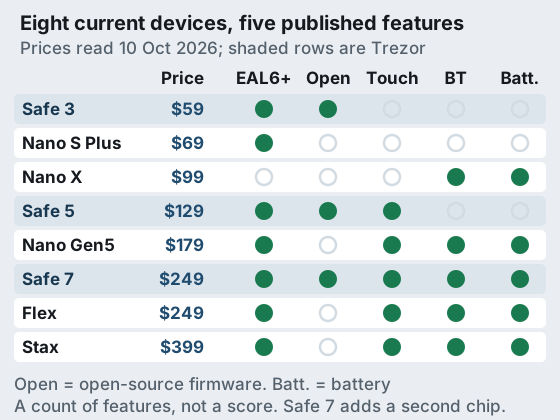
The matrix is a count of published features, not a score. Its purpose is to show that the decision is not "which brand is safer" but which combination you want: open firmware, a big screen, wireless signing, or the lowest price. Only the $249 Safe 7 ticks every box, and the two cheapest ones protect the key as well as the two most expensive.
Apps and everyday use: the companion apps compared
Day to day, you live in the companion app more than on the device. Ledger's app, which Ledger now calls Ledger Wallet after years as Ledger Live, manages accounts, swaps and staking across a very wide asset list; Ledger cites more than 15,000 supported coins and tokens. Trezor Suite is open source like the firmware and covers the major chains. If you hold an obscure asset, check each maker's supported list before buying rather than assuming either covers it.
Phone use is where the line-ups differ most. The Nano S Plus does not work with iOS at all; every other Ledger signs from an iPhone over Bluetooth. On the Trezor side, the Safe 7 is the model Trezor's compare page marks for full iOS support, using Bluetooth. If your phone is your main device and it is an iPhone, that narrows the field to the Nano X, Gen5, Flex, Stax and Safe 7. For desktop users the field stays wide open.
Security incidents on both sides, dated
A fair comparison names both brands' scars. The pattern is the useful part: across six years, the incidents that hurt customers were data leaks and phishing, not attacks that pulled keys out of devices in normal use.
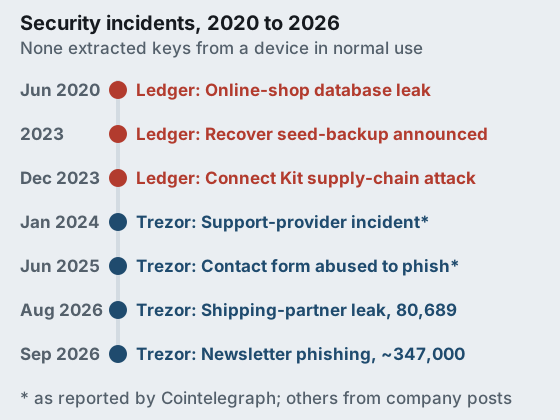
- Ledger, 2020. A database from Ledger's online shop, accessed on 25 June 2020, exposed about a million email addresses and around 272,000 records with names, postal addresses and phone numbers, per Ledger's December 2020 update. No devices, keys or funds were affected, but the list fuelled years of phishing and extortion attempts against owners.
- Ledger, December 2023. On 14 December, a former employee's phished account was used to publish malicious versions of Ledger's Connect Kit, a software library used by apps that connect to Ledger devices. Ledger says a fix was live within 40 minutes of it becoming aware, and active draining lasted under two hours. Ledger devices and infrastructure were not breached; users who approved malicious transactions in affected apps lost funds.
- Trezor, January 2024. A third-party support provider was compromised, potentially exposing the contact details of up to about 66,000 people who had contacted Trezor support since December 2021, as reported by Cointelegraph. No funds were affected by the leak itself.
- Trezor, June 2025. Attackers abused Trezor's support contact form so that automated replies looked like genuine Trezor emails carrying phishing, according to Cointelegraph's report of Trezor's warning. Trezor said its email systems were not breached.
- Trezor, August 2026. A breach at Trezor's US shipping partner exposed order data, including names, addresses and phone numbers, for 80,689 customers in total, per Trezor's own post. Devices, keys and backups were not affected.
- Trezor, September 2026. An attacker used Trezor's third-party newsletter provider to send about 347,000 subscribers a fake security alert asking for their wallet backup. Trezor says about 2,500 people clicked before it was taken down, and no Trezor product or system was affected; anyone who typed a backup into the linked page should move their funds.
There are two older scars that still shape the debate. Before the Safe line, Trezor's Model One and Model T had no secure element, and researchers showed that someone with the physical device and lab equipment could extract the seed, an attack a strong passphrase defeats. Both models are now discontinued, and Trezor says they will receive software updates until at least 2031 and critical security fixes until at least 2036. On Ledger's side, the optional Recover service, announced in 2023, unsettled owners by showing the firmware could export an encrypted form of the seed with consent; our hardware wallet ranking discusses what that means in practice.
Security note: every one of these incidents ended in the same place, a message asking for a recovery phrase or a signature. Neither company will ever ask for your 24 words. Treat any message that does as an attack, however official it looks.
Ledger vs Trezor: which to buy for which person
- You want code you can audit: Trezor. The Safe 3 at $59 is the cheapest way to get open firmware and an EAL6+ chip.
- You sign from an iPhone and want to spend little: Ledger Nano X ($99), accepting its EAL5+ chip, or step up to the Gen5 ($179).
- You want the best screen for reading transactions: Ledger's E Ink models (Gen5, Flex, Stax) or the Trezor Safe 7.
- You hold many long-tail tokens: check both supported lists before you buy; coverage of small tokens differs.
- You distrust closed firmware or seed-export features on principle: Trezor.
For most people with a computer and mainstream coins, the honest answer is that the entry models of both brands are good choices, and the decision that matters more is how you buy and how you back up. If you lean towards open source, see the current Trezor range; if you want the wider choice of screens and wireless, see Ledger's range, and our best hardware wallet ranking includes the alternatives.
Affiliate links to the manufacturer’s own store. We may earn a commission at no extra cost to you — it never moves a ranking, and buying direct from the maker (never a marketplace or reseller) is the point.
It isn't really a two-horse race
Framing cold storage as a choice between two brands leaves out devices that suit some people better. Tangem replaces the recovery phrase with two or three identical NFC cards, which suits people for whom the phrase is the weak point. Air-gapped devices such as Keystone sign by QR code with no data cable at all. Each moves the trade-offs around: a missing screen here, a less common workflow there. If neither big brand fits how you live with your crypto, our air-gapped wallets explainer is a good next read.
Setup, backup and first-day checks
Setup is close to identical on both. You create a new wallet on the device, write down the recovery phrase it shows, confirm a few words, and set a PIN; both brands also support an optional passphrase that creates a hidden wallet on top. Buy only from the maker's own store, reject any device that arrives opened or with a pre-printed recovery card, and send a small test transaction before moving your full balance. Our setup guide and seed phrase backup guide apply to either brand, and our note on hardware wallet scams covers the phishing patterns behind every incident above.
Straight answers
Is Ledger or Trezor safer?
Is the Trezor Safe 3 as secure as a Ledger?
Ledger vs Trezor: which is easier to use?
Did the 2020 Ledger breach put crypto at risk?
Which is cheaper, Ledger or Trezor?
Ready to choose a device? See the best hardware wallets, ranked by security, or follow the safe setup guide before you move a single coin.