Tangem Wallet Review: Is a Seedless Card Really a Cold Wallet?
Yes, Tangem is a genuine cold wallet in the sense that matters most: the private key is generated inside a certified secure chip on the card, it never leaves that chip, and the card is offline whenever it is not touching your phone. What it gives up is a screen of its own, so the phone becomes the only place you can read an address before you approve it. That makes it a strong, simple choice for someone who wants offline keys without a 24-word phrase to guard, and a weaker fit for anyone who wants to verify every transaction on hardware an attacker cannot reach.
This review takes Tangem's own documentation at its word where it is specific, says so where it is vague, and puts the card next to the two entry devices most buyers weigh it against. Prices and audit dates are as published on the makers' pages and dated below; nothing here comes from a lab test of our own.
How the card works: chip, NFC, and your phone as the screen
A Tangem wallet is a plastic card (or a ceramic ring) with a secure chip inside and no battery, buttons or display. The chip is powered by your phone's NFC field only while you hold the card against it. Tangem's help centre names the part as a Samsung S3D232A from the S3D350 family, and Tangem's homepage describes it as an EAL6+ certified chip developed with Samsung Semiconductors. When you create a wallet the recommended way, the chip's true random number generator makes the private key inside the card, and Tangem's security page says the company "has no mechanism to extract or reconstruct user keys".
Sending works the same way as with any hardware wallet, only over a different cable. The Tangem app builds the unsigned transaction, you enter your access code (or use biometrics), you tap the card, the chip signs internally, and only the signed transaction comes back to the phone to be broadcast. Tangem's help centre is explicit that its own servers take no part in sending or receiving: the app talks to public blockchain APIs and switches between several if one is down. Your phone, in Tangem's words, "serves as a display".
Is Tangem a cold wallet? Yes, with one caveat
"Cold" describes where the key lives, not how a device connects. By that test the card qualifies cleanly: the key is created offline on the chip, stored there, and used there. A Ledger or Trezor plugged into an online laptop is in exactly the same position, since the host computer is online while the device signs. The key never crosses the link in either case; only transactions do. If you read that Tangem is "just an app", that confuses the hardware wallet with Tangem's separate Mobile Wallet, which keeps encrypted keys on the phone itself and is a hot wallet by Tangem's own comparison table.
The caveat is the missing screen. On a device with its own display, the address and amount you approve are drawn by the device, so malware on the computer can lie on the computer's screen but not on the wallet's. With Tangem, the phone is the only display. If the phone or the app were compromised, what you see and what the card signs could in principle differ, and the card has no way to show you. That does not make Tangem unsafe; it moves one check from dedicated hardware to a general-purpose phone. For everyday sums on a phone you keep updated, that is a reasonable trade. For large, infrequent transfers, a screen you can trust is worth more.
Security note: whichever wallet you use, check the first and last several characters of the destination address against a second source before you approve, and send a small test amount first when the sum is large.
Affiliate link to the manufacturer’s own store. We may earn a commission at no extra cost to you — it never moves a ranking, and buying direct from the maker (never a marketplace or reseller) is the point.
The backup model: two or three identical cards
Instead of writing down a recovery phrase, you back up by cloning the key onto the other cards in the box. Tangem's help centre describes the process: the cards first authenticate each other, set up an encrypted channel with the Diffie-Hellman protocol, and transfer the key under a 256-bit encryption key the app itself cannot decrypt. Every card in the set ends up equivalent, with no "primary" and "backup" in practice, and any one of them can sign. The number of cards (two or three) is the number of copies of your key that exist.
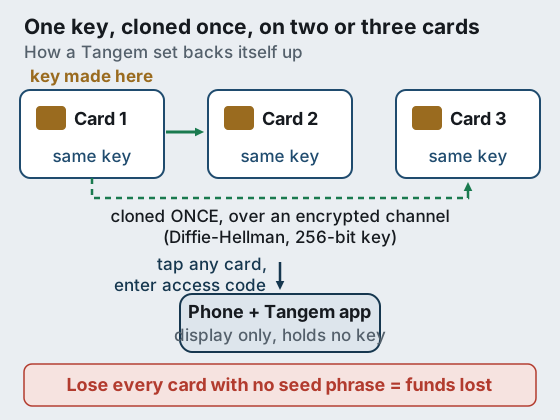
Two rules follow from that design, and both catch buyers out. First, the cloning happens once. Tangem says that for security reasons a key "can only be backed up and cloned once", so if you set up with two cards and later want a third, you must move your funds out, reset to factory settings and create a new wallet across all three. Second, if every card is lost and you did not choose the seed-phrase option, there is no recovery: "Losing all your devices will result in losing your funds," in Tangem's words. Storing the cards in different places is therefore not advice; it is the whole backup plan.
A stolen card is protected by its access code. Tangem says that after six wrong attempts each further attempt waits one second longer, up to a maximum delay of 45 seconds. That cap is worth doing the arithmetic on: at 45 seconds per guess, a thief could try roughly 1,900 codes a day, which is plenty against a four-digit code over a few days and very little against a long one. Our reading: set a long access code, not a short PIN.
Seedless by default, seed phrase if you want it
Since app version 5.9 (2 May 2024, per Tangem's security changelog), you can also create the wallet from a 24-word seed phrase, or import an existing one with a passphrase. That choice changes the security model. Seedless, the key exists only inside the chips and nobody, you included, can ever write it down or type it into a phishing site. With a seed phrase you gain a recovery path that survives losing every card, and you inherit every seed-phrase risk: paper that can be photographed, burned or found. You also lose the property that made the card unusual. Tangem's help centre lists three key-creation methods and marks on-card generation as the recommended one.
Neither option is wrong. If your realistic failure is losing things, the seed phrase is a safety net. If your realistic failure is being tricked, the seedless default removes the thing scammers ask for. Pick the one that covers the mistake you are more likely to make, and write that reasoning down for whoever inherits your crypto.
Audits and certification: what is actually published
Tangem's security page lists three external reviews, each summarised as "No critical vulnerabilities found": Kudelski Security on the smartcard code (2018), Riscure on the mobile hardware wallet and firmware (December 2023), and Cure53 on the iOS and Android mobile wallet (March 2026). The mobile app's source is public on GitHub, including the Android APK, so the app survives even if it were pulled from the app stores. The card's own firmware is described as reviewed by Kudelski and Riscure, not as open source, and that is the honest limit: you can read the app, but you take the chip's code on the auditors' word.
On certification, the EAL6+ claim appears on Tangem's homepage and on its Ring product page; the dedicated security page talks only of a "certified secure element" without naming the level. Older reviews that cite a Kudelski audit of the app have the scopes mixed up: per Tangem's list, Kudelski looked at the smartcard code, and the latest app audit is Cure53's. Tangem also backs the card with a 25-year limited hardware warranty.
Price and what's in the box (as of 10 Oct 2026)
Tangem prices move with promotions more than most makers' do. On 10 October 2026, read from a US connection, tangem.com showed the following, with an "extra 10% off" banner running until 25 October. An earlier read from outside the US had shown a lower two-card price, so treat any figure here as a snapshot and check the pricing page on the day you buy.
| Set | Listed price | What it means |
|---|---|---|
| 2 cards | $59.90 | One spare copy of the key. The minimum workable backup. |
| 3 cards | $69.90 | Two spares, so one can live off-site. Our default pick. |
| Family Pack | $139.80 | Two separate wallets, each with its own cards. |
| Ring & 2 cards | $140.00 (list $160.00) | Ceramic ring with a CC EAL6+ chip, rated IP69K. |
| Pro Kit | $180.00 | Tangem's "everything in one box" bundle; same chip and backup model. |
The three-card set is the one to buy unless money is very tight. The extra card costs $10 at the listed prices and lets you keep one copy at home, one in a second location and one on you, which is the configuration the backup model was designed around. Buy from tangem.com rather than a marketplace seller: a card that arrives already activated, or with a wallet already on it, should go straight back. If you want the three-card set, it is listed on Tangem's own store.
Tangem vs Ledger vs Trezor
The fair comparison is with each rival's entry model, since that is where Tangem's price sits. All three use a secure element certified to EAL6+, all three keep the key offline, and all three cost well under $100. They differ on the two things this review keeps returning to: whether the device has its own screen, and how you back it up.
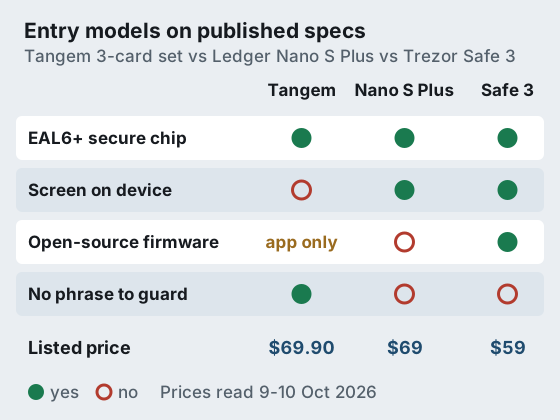
| Factor | Tangem (3 cards) | Ledger Nano S Plus | Trezor Safe 3 |
|---|---|---|---|
| Secure element | EAL6+ (Samsung chip) | CC EAL6+ (ST33K1M5) | Certified EAL6+ |
| Screen on device | None (phone is the display) | 1.1in OLED | 0.96in monochrome, two buttons |
| Connection | NFC to phone | USB only; no iOS | USB-C |
| Backup | Cloned cards (seed optional) | Recovery phrase | Recovery phrase |
| Open source | App yes; card firmware audited, not published | No (closed OS) | Yes |
| Listed price | $69.90 | $69 (shop.ledger.com, 10 Oct 2026) | $59 (trezor.io) |
Read across the rows and the choice sorts itself. If verifying on a dedicated screen matters most, the Trezor Safe 3 does that for less money and adds open-source firmware; see the current Trezor line-up. If you live on an iPhone, note that the Nano S Plus does not work with iOS at all, while Tangem works with any NFC phone. If the thought of guarding 24 words on paper is what has kept you on an exchange, Tangem removes that obstacle more completely than anything else here, and that alone can make it the safer choice for you. Our broader hardware wallet ranking covers the air-gapped options too.
Affiliate links to the manufacturer’s own store. We may earn a commission at no extra cost to you — it never moves a ranking, and buying direct from the maker (never a marketplace or reseller) is the point.
Who it suits, and who should skip it
It suits people for whom the recovery phrase is the weak link: newcomers moving coins off an exchange for the first time, holders who travel, and anyone who wants family members to be able to sign without learning seed-phrase hygiene. It also suits phone-first users, since there is no cable, no charging and nothing to update on the card itself.
Skip it, or pair it with a screened device, if you regularly move large sums, interact with smart contracts where reading the exact transaction matters, or simply do not trust your phone. Skip it too if you know you will not keep the cards apart. A wallet whose backup is three identical cards in one drawer has one point of failure, the drawer, and no amount of chip certification fixes that.
Edge cases that catch owners out
- You lose one card. Nothing happens to the funds; the others still sign. You cannot add a replacement to the same wallet, so buy a new set and move your funds across when convenient.
- You forget the access code. Tangem says you can reset it in the app, but the reset needs the card and a second card from the same set to confirm. If you are down to a single card, a forgotten code cannot be reset.
- Your phone breaks. The phone holds nothing secret. Install the app on another phone, scan a card and enter the access code.
- The app disappears from the stores. The installed version keeps working, and the code and Android APK are published on Tangem's GitHub.
- Tangem the company stops trading. Signing happens on the card and broadcasting goes through public APIs, so the wallet does not depend on Tangem's servers. Your fallback is the open-source app, which is a good reason to bookmark that repository now.
Notice that every one of these scenarios has a clean answer except the one nobody plans for: losing every card at once. That is a fire, a flood or a burglary, and it is why separate locations are not optional. If a second location is not realistic for you, choosing the seed-phrase option and storing the words properly is the better trade, and our seed phrase backup guide covers how.
Buying and setting it up safely
Order from the maker, check that the cards arrive sealed and unactivated, and let the app's authenticity check run, which needs one online scan per card so the app can download the certificate that proves Tangem made it. Create the wallet with all the cards you intend to use in a single session, because you will not get a second chance to add one. Choose a long access code, then test a small receive and send before moving anything substantial. Finally, put the cards where they need to live: apart. Our general setup guide walks through the same first-day checks for any device, and the note on buying direct explains why the marketplace discount is never worth it.
Straight answers
Is Tangem a cold wallet?
Is Tangem a good cold wallet?
Tangem vs Trezor: which is safer?
What happens if I lose my Tangem card?
Does Tangem have a seed phrase?
Ready to choose a device? See the best hardware wallets, ranked by security, or follow the safe setup guide before you move a single coin.